

Somewhere along the way, you’ll sink into one of those hot springs at the base of a volcano and feel it: the same fire that shaped this land is the one warming your legs now. It’s a feeling that stays with you long after the ride ends, the quiet proof that this landscape and your own effort are connected in a very literal way.
That’s the thread running through this journey, from the Araucanía’s ancient forests to the lake country of Los Lagos. A living landscape still shaped by fire today, and the ancestral territory of the Mapuche people,
Summary
Group Size: 5 to 9 participants
Target Audience: Experienced bike touring enthusiasts
Season: November to April
Start Location: Malalcahuello
Finish Location: Puerto Varas
Total Duration: 13 days
Riding Days: 11
Total Distance: 382 miles (615 km)
Difficulty: Moderate to Challenging
Terrain: Paved roads, gravel sections, and converted railway paths
Accommodation: Boutique hotels and wild camping
Target Audience: Experienced bike touring enthusiasts
Season: November to April
Start Location: Malalcahuello
Finish Location: Puerto Varas
Total Duration: 13 days
Riding Days: 11
Total Distance: 382 miles (615 km)
Difficulty: Moderate to Challenging
Terrain: Paved roads, gravel sections, and converted railway paths
Accommodation: Boutique hotels and wild camping
Distance per day
- Day 1: 37mi (60km)
- Day 2: 48mi (78km)
- Day 3: 33mi (54km) Including boat crossing
- Day 4: 30mi (49km)
- Day 5: 33mi (53km)
- Day 6: 10mi (16km)
- Day 7: 27mi (43km)
- Day 8: 45mi (73km)
- Day 9: 39mi (63km)
- Day 10: 38mi (61km)
- Day 11: 41mi (65km)
Hightlights
- Cycle along 9 lakes, from lava-dammed Conguillío to Llanquihue, framed by the Osorno and Calbuco volcanoes.
- Encounter 6 iconic volcanoes: Lonquimay, Llaima, Villarrica, Puyehue, Osorno, and Calbuco.
- Boat across Lago Caburgua.
- Descend by bike through the private valley of the Huilo-Huilo Biological Reserve.
- Ride through Conguillío and Villarrica National Parks.
- Ride through Conguillío and Villarrica National Parks, crossing two UNESCO-recognized territories: the Kütralkura Global Geopark and the Temperate Rainforests of the Southern Andes Biosphere Reserve.
- Stay at renowned hotels and hot springs, including Malalcahuello Hotel & Spa, Termas Geométricas , Antumalal Hotel in Pucón and close the expedition at Hotel Cumbres Puerto at Puerto Varas, on the shores of Lago Llanquihue.

Trip Details
The Journey of Fire is a fully supported cycling journey covering nearly 630 km through the heart of the southern Andes, entirely within Chile. Spanning 13 days, including 11 full days of riding, it connects some of the most awe-inspiring landscapes of the Araucanía, Los Ríos, and Los Lagos regions.
The route has been carefully designed to prioritize scenic, low-traffic roads rich in natural and cultural heritage, allowing for deep immersion in remote, pristine environments where cycling becomes a privileged way to connect with the land and its people. To balance comfort, adventure, and rest, the itinerary alternates between two lodging styles: six nights camping and six nights in boutique hotels and lodges.
Camps
-
Camping Los Ñirres (Conguillío National Park)
-
Camping Codihue (Lake Colico)
-
Private camp in Villarrica National Park
-
Camping Huechulafquén (Lake Neltume)
- Riverside camp in the Pillanleufu Valley
-
Camping Centinela (Puerto Octay)
Hotels
- Malalcahuello Hotel & Spa
- Hotel Antumalal (Pucón)
- Nothofagus Hotel & Spa or Montaña Mágica Lodge (Huilo Huilo)
- Ranco Lodge (Lago Ranco)
- Hostería Entre Lagos
- Hotel Cumbres Puerto Varas.
Route Logistic
The expedition is designed to be completed entirely by bicycle, except for one scenic lake crossing: Lago Caburgua, crossed by boat along with the bicycles.
A custom-built trailer carries all personal luggage, camping equipment, and the expedition kitchen, allowing each cyclist to travel light and focus entirely on enjoying the ride.
All camps are fully prepared by our support team before the group arrives, including high-quality tents, a dining area, and a kitchen. A chef will travel with the driver, in charge of all provisions and responsible for preparing delicious breakfasts and dinners for the camping nights.
Flavors & People
All lunches are enjoyed with local restaurants or families who open their homes to us, sharing traditional recipes and fresh, seasonal products from their land. These moments create genuine cultural exchanges while directly supporting those who keep the region’s culinary heritage alive.
In the end, this journey is not only about cycling through spectacular landscapes. Every meal is part of the adventure, a celebration of local culture that nourishes both body and spirit.
Support & Safety
-
Fully equipped support van and custom-built trailer with capacity to carry the group, bicycles, camping gear, tools, kitchen, and personal luggage.
-
Professional bike mechanic traveling with the group to resolve any mechanical issues.
-
Trip Leader and Assistant Guide certified in WAFA (Wilderness Advanced First Aid) and trained to handle emergencies.
-
Transport assistance for any participant unable to complete a day’s ride, with space for both rider and bike.
-
Weather contingency plans to transfer the group and bikes to the next lodging point or a safe alternative in case of severe conditions.
January 2024 and others. Summer.




Itinerary Overview
11 days of cycling– 382 miles
Day 0 — Arrival and Welcome
Nestled at the foot of the Lonquimay Volcano, surrounded by ancient forests and Andean landscapes, Malalcahuello is the perfect setting to begin our journey into the heart of southern Chile.
Private transfer from Temuco Airport to your accommodation at Malalcahuello Hotel & Spa (approx. 1 hour and 45 minutes). Upon arrival, you’ll be welcomed by the lead guide and support team for a short orientation, including a briefing on the journey ahead, equipment check, and bike fitting.
You’ll then have free time to go for a light ride around the area or relax at the hotel’s natural hot springs and spa facilities.
In the evening, we’ll gather for a delicious welcome dinner, a perfect opportunity to connect with fellow travelers and enjoy regional flavors in a warm and relaxed atmosphere.
We’ll assist all participants in coordinating flights from Santiago to Temuco to ensure the group travels together. Alternatively, private pick-up on Day 0 is also available from Pucón or Temuco city upon request. Please see the section for flight recommendations.
Day 1 — Malalcahuello → Conguillío National Park
📍 Distance: ~55 km
📈 Elevation gain: ~680 m
🛏️ Accommodation: Los Ñirres Campsite
💡 Highlights: Cautín Valley, waterfalls, Araucaria forests, Llaima Volcano
Our cycling journey begins with a gentle descent through the scenic Cautín Valley, following the route of the long-forgotten trans-Andean railway, which has now been adapted into a cycling path. After reaching the town of Melipeuco, we’ll leave behind the traffic and noise to enjoy a peaceful 14-kilometer paved bike trail.
Along this stretch, we’ll visit two beautiful waterfalls: Salto del Indio and Salto de la Princesa, both nestled in lush native forest. From there, we take a lesser-known gravel shortcut that reconnects with the main road, which leads us to the northern entrance of Conguillío National Park.
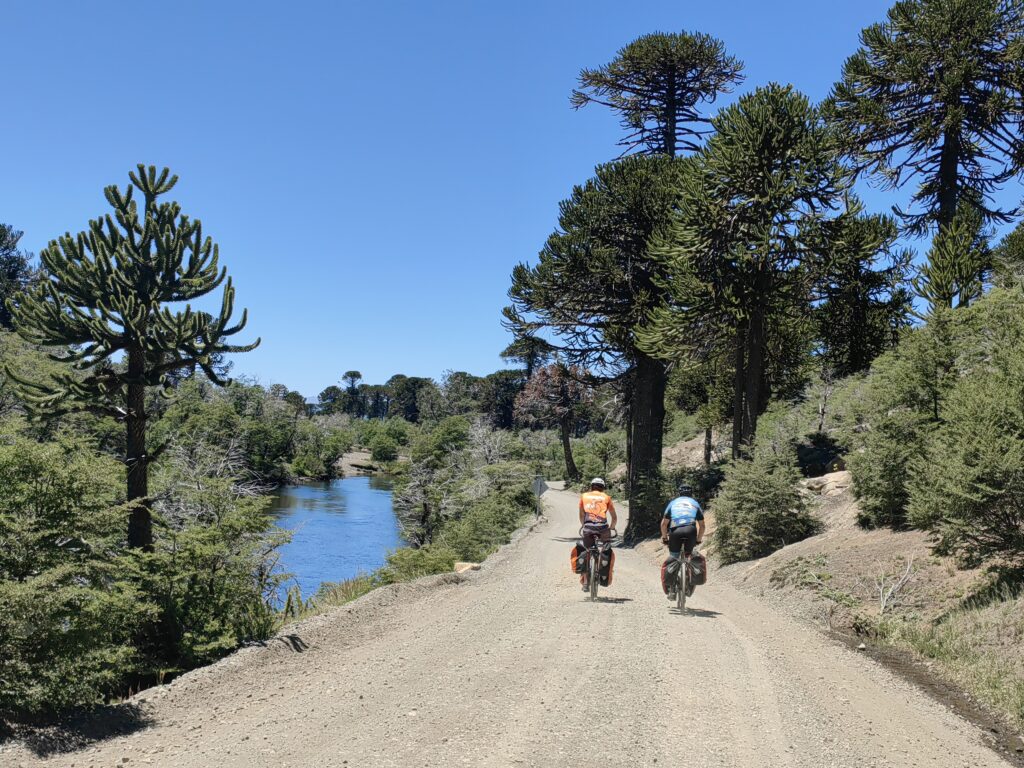
The final section of the day is the most physically demanding, as we climb approximately 680 meters over 20 kilometers. This challenging ascent brings us deeper into pristine wilderness, where we’ll be surrounded by iconic Andean lagoons, the impressive Llaima Volcano, and ancient Araucaria trees — also known as monkey puzzle trees. These remarkable conifers gave their name to both the Araucanía region and the “Araucanos“, the historical name given by the Spanish to the native Mapuche people of this territory.
We’ll end the day at a well-equipped campground near Lake Conguillío, surrounded by Araucaria and Coigüe trees. This beautiful campsite offers showers, bathrooms, and a food service area — the perfect place to rest, recharge, and enjoy a night immersed in nature.
Day 2 — Conguillío → Melipeuco → Lake Colico
📍 Distance: ~78 km
📈 Elevation gain: Gentle descent
🛏️ Accommodation: Camping Codihue
💡 Highlights: Arcoíris & Verde Lagoons, lava fields, local lunch
Descend to the town of Melipeuco, then continue through pastoral lands toward the serene Lake Colico.
We begin the day riding along a friendly, mostly flat gravel road surrounded by an extraordinary native forest, one of the oldest and most biodiverse in the region. The trail gradually descends, taking us past picturesque lagoons like Laguna Arcoíris and Laguna Verde, which add color and narrative to this Jurassic landscape.
Soon after, the scenery becomes more dramatic as we enter a lava field set at the base of the imposing Llaima Volcano — a powerful reminder of the volcanic forces that have shaped this territory. From there, we exit the southern gate of Conguillío National Park and transition to smoother riding.
The rest of the route follows quiet paved roads and a flat stretch of highway, with no significant climbs. Around midday, we’ll stop at a local guest house near Melipeuco, where we’ll enjoy a homemade lunch featuring authentic regional cuisine and warm southern hospitality.
In the afternoon, we continued our ride southward until reaching a beautiful campsite on the shoreline of Lake Colico — an ideal spot to unwind, swim, and enjoy a peaceful evening surrounded by native trees and clear waters.
Day 3 — Lake Colico → Pucón (via Lake Caburgua)
📍 Distance: ~51 km
🛥️ Boat crossing: Lake Caburgua
🛏️ Accommodation: Antumalal hotel
💡 Highlights: Rural roads, Ojos del Caburgua, free evening in Pucón
We start the day cycling 28 kilometers along the northern shoreline of Lake Colico, following quiet rural roads that offer beautiful views of the lake and surrounding forest. At the northern dock of Lake Caburgua, we’ll board a boat that will carry us — along with our bicycles — across the entire length of this pristine glacial lake.
Once we reach the southern shore of Lake Caburgua, only 23 kilometers remain to reach the most iconic tourist destination in the region: the town of Pucón.
Before arriving, we’ll have the chance to visit the Ojos del Caburgua — a set of deep-blue natural spring pools surrounded by lush native forest, where underground waters from Lake Caburgua resurface in a stunning cascade display.
Upon arrival in Pucón, the group will have the afternoon free to explore this vibrant mountain town on foot. Dinner is not included, but you’ll have plenty of options to choose from among Pucón’s excellent restaurants and cozy eateries.
Day 4 — Pucón → Villarrica National Park
📍 Distance: ~52 km
📈 Elevation gain: ~1,000 m
🛏️ Accommodation: Campsite (remote)
💡 Highlights: Waterfalls, wild trail access, Termas Geométricas
This is likely the most challenging day of the expedition, but it comes with an incredibly rewarding ending.
We leave Pucón early and begin a steady ascent through the lush Palguín valley. Over the course of the day, we’ll gain nearly 1,000 meters of elevation as we enter Villarrica National Park via its northern access, a remote trail closed to vehicles but perfect for adventurous cyclists seeking solitude and raw nature.
Along the way, we’ll take time to admire several beautiful waterfalls, including Salto Las Mellizas, Salto Palguín, and Salto La China — each surrounded by vibrant temperate rainforest and fed by crystal-clear mountain waters.
After crossing the park and reaching our remote campsite, we’ll hop into our support van for a short 10-minute transfer to one of Chile’s most iconic hot springs: the Termas Geométricas. Hidden deep within a narrow canyon and surrounded by native forest and waterfalls, this thermal complex offers the perfect restorative soak after a physically demanding ride.
We’ll return to our campsite in the early evening, where our chef will be waiting with a well-deserved dinner to end this unforgettable day.
Day 5 — Villarrica NP → Coñaripe → Lake Neltume
📍 Distance: ~65 km
📈 Terrain: Mixed gravel/paved
🛏️ Accommodation: Camping Huechulafquén
💡 Highlights: Lake Calafquén, rural landscapes, Andes foothills
We begin the day descending from our campsite along the southern slopes of Villarrica Volcano, following a 20-kilometer gravel road that is both thrilling and scenic. This stretch offers panoramic views of surrounding peaks and valleys, eventually leading us to the small town of Coñaripe, located on the eastern shore of Lake Calafquén.
In the afternoon, we continue pedaling south on a well-maintained paved road, gently rolling through rural landscapes dotted with farms, forests, and traditional wooden houses. As we approach the Huilo Huilo Reserve area, the landscape becomes greener and more dramatic, with glimpses of rivers, lakes, and the surrounding Andes foothills.
Our final destination is Lake Neltume, a quiet and pristine body of water nestled between forests and mountains. Here, we’ll spend the night at Camping Huechulafquén — a peaceful, lakeside site ideal for a refreshing swim, a stroll along the shoreline, and some well-earned rest.
Day 6 — Lake Neltume → Huilo Huilo Reserve
📍 Distance: ~18 km
🛏️ Accommodation: Nothofagus or Montaña Mágica Lodge
💡 Highlights: Short ride, Huilo Huilo River, afternoon free in the reserve
This is the least demanding day of the entire journey, offering a perfect balance between light pedaling and deep immersion in nature.
We start the day cycling along a quiet gravel road that gently follows the shoreline of Lake Neltume for about 6 kilometers, with only mild ups and downs. We then connect to a paved road with a designated bike lane, which guides us uphill alongside the powerful Huilo Huilo River, as we make our way into the Biological Reserve.
The afternoon is free to enjoy the serene natural setting of the reserve. The Huilo Huilo Biological Reserve is a private conservation area located in the heart of the Valdivian temperate rainforest. Known for its breathtaking scenery, rich biodiversity, and unique forest architecture, the reserve offers a peaceful setting to reconnect with nature. Its lush trails, waterfalls, and thermal springs make it a magical stop in the journey — perfect for relaxing and exploring at your own pace.
After several days of intense riding, this is an ideal moment to slow down, reconnect with nature, and recharge for the next stage of the journey.
Day 7 — Huilo Huilo Reserve → Pillanleufu Valley
📍 Distance: ~42 km
📈 Elevation loss: ~500 m
🛏️ Accommodation: Riverside camp, Pillanleufu Valley
💡 Highlights: private reserve road, pristine valley, Pillanleufu River, huemul conservation
After a good breakfast at the hotel, we head out on a private road deep within the reserve, leading into a valley of native forest that remains largely untouched. This same territory is home to the Fundación Huilo Huilo’s breeding program for the huemul, the southernmost deer in the world and a national symbol of Chile, now critically endangered.
The entire day is downhill. We follow the course of the Pillanleufu River, losing close to 500 meters of elevation over 42 kilometers, through dense forest with the constant sound of the river running alongside us.
We leave the valley right on the riverbank, where our support team will already have camp set up and dinner waiting by the water.
Day 8 — Pillanleufu Valley → Lake Ranco (town)
📍 Distance: ~70 km
🛏️ Accommodation: Ranco Lodge (private family house)
💡 Highlights: Puerto Las Llolles, northern shore of Lake Maihue, arrival at the town of Lago Ranco
We leave our riverside camp on the Pillanleufu and follow a gravel road that traces the valley westward, through open pastureland and low forest, all the way to Arquilhue. At Puerto Las Llolles the road turns to pavement and briefly touches the northern shore of Lake Maihue — the same water we watched running downstream from our camp the day before, now open and still.
From there, smooth paved roads carry us past the small settlements of Liffén and Molina to Riñinahue, on the eastern edge of Lake Ranco, where we’ll stop for lunch and recover some energy before the final stretch.
The afternoon continues along the lake’s costanera, now with its own dedicated bike path, all the way into the town of Lago Ranco. We’ll spend the night together as a group in Ranco Lodge’s private family house, right on the water — spacious enough for the whole group under one roof, where our chef will prepare dinner and we can share the close of a long day together.
Day 9 — Lake Ranco → Entre Lagos
📍 Distance: ~64 km
📈 Terrain: Mostly flat
🛏️ Accommodation: Hostería Entre Lagos
💡 Highlights: Los Ríos countryside, Pilmaiquén, first views of Volcán Puyehue
We leave Lago Ranco heading northwest, leaving the lake behind as the landscape opens into open farmland: pastures, second-growth forest, and wooden farmhouses scattered across the rolling hills of the Los Ríos region.
We pass through the small settlement of Crucero and continue along mostly flat rural roads, winding gently between small agricultural valleys. After the demanding days through the Pillanleufu valley and Lake Ranco, this is a quieter stretch, perfect for conversation as the countryside rolls by.
Toward the end of the day, we reach Pilmaiquén, where the river of the same name begins at the outlet of Lake Puyehue. We cross into Entre Lagos, a small lakeside town with Volcán Puyehue rising in the distance.
We’ll spend the night at Hostería Entre Lagos, right on the water, closing out a day that’s long in kilometers but easy on the legs.
Day 10 — Entre Lagos → Puerto Octay (Camping Centinela)
📍 Distance: ~61 km
📈 Terrain: Rolling, with gentle climbs and descents
🛏️ Accommodation: Camping Centinela (Club Pesca y Caza Centinela)
💡 Highlights: Los Lagos farmland, first views of Lake Llanquihue and Volcán Osorno
We leave Entre Lagos heading south, leaving the Puyehue valley behind on quiet rural roads that roll gently through pastures and small settlements like Río Negro and Purranque. It’s an easy, undemanding stretch that slowly brings us into a different kind of landscape.
After a full day riding through inland farmland, the road opens up all at once: there’s Lake Llanquihue, the largest lake of the entire trip, with Volcán Osorno rising across the water. It’s a view travelers have been photographing for almost a century, and now we get to see it with our own tired legs behind it.
We end the day on the Centinela peninsula, camping at the Club Pesca y Caza Centinela, right on the lakeshore. The perfect close before the final day of this expedition.
Day 11 — Puerto Octay → Frutillar → Puerto Varas
📍 Distance: ~68 km
📈 Terrain: Rolling, with coastal stretches
🏁 Trip finish: Puerto Varas
💡 Highlights: Lake Llanquihue costanera, Frutillar, Teatro del Lago, exclusive closing dinner
We leave the Centinela peninsula and follow the eastern shore of Lake Llanquihue, on a rolling road that winds through riverside forest and small hamlets. The lake stays in view the whole way, with Volcán Osorno watching over us from across the water.
By midday we reach Frutillar, founded by German settlers in the mid-19th century and still recognizable today in its wood-shingled houses and orderly lakeside promenade. Right on the water stands the Teatro del Lago, built in 2010 on 56 pillars driven into the lake, its wood-clad design echoing the same architecture the town’s founders brought with them.
We’ll stop for lunch at Club Alemán de Frutillar, just steps from the theater — traditional German fare, and, to finish, a proper slice of kuchen or apple strudel, the pastry Frutillar does better than anywhere else in southern Chile.
From there, the final kilometers follow the costanera south to Puerto Varas, with Volcán Osorno and Volcán Calbuco keeping us company all the way down.
We’ll check into Hotel Cumbres Puerto Varas, right on the lake, with those same mountains now framed in the window. There, at the hotel’s own restaurant, Cumbres del Lago, we’ll close the expedition with an exclusive farewell dinner, looking out at the same Osorno that’s followed us for the past two days — this time with a glass of wine in hand instead of a handlebar.
This is where the expedition ends: eleven days after leaving Malalcahuello, the same legs that crossed valleys of ash and rivers of meltwater finally reach a lake that brings together, once more, the fire we saw above and the water that welcomes us below.
Day 12 — Departure
📍 Transfer distance: ~22 km (30 min drive)
🏁 Departure point: El Tepual International Airport (PMC), Puerto Montt
💡 Highlights: free morning in Puerto Varas, assistance packing bikes for the flight home
The morning is free — time to wander Puerto Varas at your own pace, pick up a last souvenir, or simply relax by the lake before heading home. Our team will be on hand to help disassemble and pack your bicycle, providing sturdy bike boxes and everything needed for safe transport.
When you’re ready, a private transfer takes the group to El Tepual International Airport (PMC), about 22 km and 30 minutes from Puerto Varas, for your onward flight.
Our services officially end here — eleven days of pedaling through fire and water, forests and volcanoes, now behind you. ¡Hasta pronto!
Route Map
10 days – 382 miles
Key Policies
- Group Size: Min. 6 – Max. 9 participants for the 2026 season. If the minimum is not met 30 days before departure, we reserve the right to cancel and issue a full refund.
- Payment: 50% deposit to secure your spot. Balance due before the expedition starts.
- Cancellation Policy: Full refund for cancellations due to low group numbers or unavoidable events beyond our control.
- Weather & Conditions: Tours run rain or shine, but may be adjusted for safety in extreme weather.
- Gear: Touring bike, helmet, sleeping bag, and mattress not included — available for rental on request.
- Support Vehicle: Van with trailer for all participants, bikes, equipment, and luggage. Includes on-route resupply.
- Respect for Nature & Communities: Participants are expected to respect the environment, wildlife, and local people along the route.
What’s included?
Not Included
-
Domestic and international flights
-
3 dinners (Pucón, San Martín de los Andes, and Villa La Angostura)
-
Touring bike (available for rent)
-
Personal equipment, including:
• Helmet
• Handlebar bag
• Saddlebag
• Sleeping bag
• Sleeping mat
(All available for rent upon request) -
Travel insurance (required)
-
Alcoholic beverages, personal snacks, and optional side activities
-
Gratuities for guides and crew (optional but appreciated)
Included
-
12-Day Fully Supported Cycling Tour
Led by an experienced bilingual guide with deep regional knowledge and a dedicated support team. -
All Accommodations
• 6 nights in boutique hotels or cozy lodges
• 7 nights in fully equipped campgrounds (group tents, kitchen, and shared infrastructure provided) -
Meals
• Daily breakfast
• 12 lunches served at local restaurants
• 9 dinners, including welcome and farewell meals -
Support Vehicle & Gear Trailer
• Private van with full seating capacity for all participants, offering assistance during the ride for rest, emergencies, or transfers
• Dedicated gear trailer to transport all bikes, luggage, and camping equipment
• En-route provisioning with water, snacks, and mechanical assistance -
Professional Expedition Team
• Lead cycling guide, support driver, assistant guide, and expedition cook -
Entry Fees
• All National Park admissions and hot springs access -
Ferry Crossings
• Caburgua and Pirihueico Lakes (Chile) -
Bike Packing Assistance
• Bike boxes and packing support on the final day for a safe return home -
Airport Transfers
• From Temuco Airport (ZCO) to Malalcahuello on arrival day
• From Puerto Varas to Puerto Montt Airport (PMC) on departure day -
Domestic Flight Coordination
• Assistance with internal flight planning to ensure group cohesion
FAQ
1. Who is this expedition for?
Whether you are an experienced cyclist or an adventurous traveler seeking a new challenge, this journey invites you to pedal through some of the most spectacular landscapes in the Southern Andes, with the support and comfort you need to fully enjoy the experience.
2. How difficult is the route?
The route is designed for cyclists in good physical condition who are comfortable riding multiple days in a row. We average approximately 67 km per day over varied terrain, including a mix of paved and gravel roads. While the support vehicle is always available, participants should be prepared for sustained pedaling and moderate elevation gains.
3. How many participants are in the group?
We operate in small groups of 5 to 9 cyclists to ensure a personalized experience and maintain close contact between participants and guides.
4. What kind of bikes do you recommend?
A gravel or touring bike with 35–45 mm tires is ideal for the mixed surfaces along the route. E-bikes are welcome, but participants must ensure battery autonomy for each day’s ride. We also offer bike rentals, which can be booked in advance for an additional cost.
5. Do I need to carry my own luggage?
No. All personal luggage, camping equipment, and kitchen gear are carried in a custom-built trailer that travels with the support vehicle. This allows cyclists to ride light and focus on the enjoyment of the journey.
6. What type of accommodation will we stay in?
We alternate between high-quality camping and boutique hotels. Camps are fully set up by our team, including tents, a dining area, and a kitchen where our chef prepares delicious breakfasts and dinners. Hotels are selected for their location, comfort, and wellness services.
7. What happens in case of bad weather or if I cannot complete a day’s ride?
The support vehicle will transport you and your bike to the next accommodation or to a safe point along the route. In case of severe weather conditions that may compromise safety, the vehicle will be used to move the group to a suitable location. Our priority is always the safety and well-being of participants.
8. What kind of meals are included?
Breakfasts and dinners at camp are freshly prepared by our expedition chef. Lunches are provided by local restaurants or families along the route, offering authentic regional dishes. During the ride, our team provides on-route supplies including isotonic drinks, hot beverages, fruits, cereals, and chocolate, among others. We are fully prepared to meet all dietary requirements, whether gluten-free, vegetarian, or other needs communicated in advance.
9. Are there any age restrictions?
Participants must be at least 16 years old and in good physical condition. Minors must be accompanied by an adult.
10. Do I need travel insurance?
Yes. Comprehensive travel insurance, including medical coverage and evacuation, is mandatory for all participants.
11. What is the booking and payment process?
A first payment of 50% is required to secure your spot, with the remaining 50% due before departure. Payments can be made via bank transfer or online payment platform.
12. What should I pack for the expedition?
We will provide a detailed packing list once your booking is confirmed. Essential items include a suitable bike (or arrange a rental with us), helmet, layered cycling clothing, rain gear, and personal items for comfort at camp and hotels.
Which airport should I fly into for the expedition?
The expedition officially begins at Temuco Airport (ZCO) in southern Chile. Domestic and international flights are not included in the package; however, we will gladly assist you in selecting the most suitable options. Our goal is to suggest flights that allow participants to arrive at similar times, ensuring an optimal group meeting and a smooth start to the journey.
The expedition officially begins at Temuco Airport (ZCO) in southern Chile. Domestic and international flights are not included in the package; however, we will gladly assist you in selecting the most suitable options. Our goal is to suggest flights that allow participants to arrive at similar times, ensuring an optimal group meeting and a smooth start to the journey.
A typical flight from Santiago (SCL) to Temuco (ZCO) takes about 1 hour and 20 minutes, with several daily departures operated by LATAM and Sky Airlines. Once your booking is confirmed, we will provide guidance and recommendations for coordinating these flights.
At the end of the expedition, we will help you arrange your return from Puerto Montt Airport (PMC) back to Santiago. The flight takes about 1 hour and 40 minutes, and the airport is located approximately 25 km (30 minutes) from Puerto Varas. Most travelers schedule this return flight for the day after the expedition ends, although special arrangements can be made upon request.
For those arriving earlier or preferring a customized service, private pick-up on Day 0 is also available from Temuco city or Pucón.
If you choose to bring your own bicycle, our team will guide you through the packing and unpacking process to ensure your bike is safely transported and ready for the adventure.
Traveler Reviews